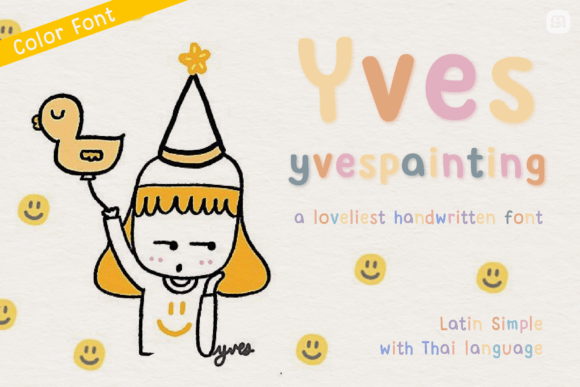
Why Yves Yvespainting Brings Whimsy to Your Design Projects
There are moments in design when you need typography that does more than just convey words—you need it to convey feeling. A playful scribble here, an authentic brushstroke there, and suddenly your project has a heartbeat. That's the kind of energy Yves Yvespainting brings to the table. It's not just another creative font; it's a color font that arrives with personality baked right in, designed for those projects where joy and authenticity matter as much as legibility.
Before diving into all the ways you can put this typeface to work, let's get one important detail out of the way. Yves Yvespainting is an OpenType-SVG color font, which means it carries actual color information within the font file itself. That's what gives it that hand-painted, vibrant quality right out of the box. It works beautifully in PhotoShop, Illustrator, Silhouette, and Inkscape, but it's worth noting that OTF and TTF files of this product are not compatible with Cricut. If you're new to working with color fonts, the Ultimate Font Guide is a solid resource to get comfortable with the format before you start.
A Typeface That Feels Like a Saturday Morning
What makes Yves Yvespainting visually appealing is its unapologetic sense of fun. The letterforms look like they were painted by hand—maybe by a creative kid who just discovered a new set of brushes, or by an artist channeling that same uninhibited energy. The strokes are organic, the colors are rich, and the overall effect is something that feels genuinely warm rather than manufactured.
This isn't a font that tries to be everything. It leans into its whimsical nature with confidence. The brush texture adds depth, and the built-in color means you're not stuck trying to layer effects or apply gradients in post-production. You set the type, and it arrives looking like a small piece of art. For anyone who's spent hours trying to make standard fonts look "handmade" with layer styles and textures, that's a genuine time-saver.
Where This Font Actually Shines
Not every project calls for a playful, hand-painted display font. But when it fits, it fits perfectly. Here are some real-world scenarios where Yves Yvespainting earns its place in your toolkit:
- Children's activity books and educational materials: This is the most obvious home for a font like this. Cover titles, chapter headings, activity labels, and reward stickers all benefit from that hand-crafted, approachable look.
- Kids' party invitations and event materials: Birthday invitations, baby shower signage, school event posters—anywhere you want to signal "this is going to be fun" before anyone reads a single word.
- Packaging for children's products: Toy boxes, snack labels, craft kit packaging. The font does the heavy lifting of communicating a brand's personality at a glance.
- Social media graphics: Instagram posts, story templates, YouTube thumbnails, and Pinterest pins aimed at parents, teachers, or kid-focused brands. The color font format makes these graphics pop without additional editing.
- Blog headers and website accents: A whimsical blog about parenting, homeschooling, or kids' crafts can use Yves Yvespainting for section headers or featured image overlays to create visual consistency across content.
- Merchandise and print-on-demand: T-shirts, tote bags, mugs, and stickers aimed at a younger audience or a playful adult market. The built-in color translates well to print production.
- Digital products: Printable worksheets, coloring pages, flashcards, and educational PDFs where the visual tone needs to feel inviting and encouraging.
For small business owners in the kids' product space, having a font like this on hand means you're not constantly hiring a designer for every small graphic need. It gives you a consistent visual language that's immediately recognizable to your audience.
Pairing Yves Yvespainting with Other Fonts
A display font this expressive works best when it's balanced with something quieter. Think of it like a conversation—you don't want everyone shouting at once. Here are a few practical pairing strategies:
- With a clean sans serif: Pair the whimsical headers with a straightforward sans serif for body text. Fonts like Open Sans, Lato, or Montserrat keep things readable without competing for attention.
- With a soft handwritten font: If your project has a casual, personal tone, a simple handwritten companion font for subheadings or short descriptions can work well—as long as it's significantly less ornate than Yves Yvespainting.
- With a rounded serif: For a slightly more polished look—think editorial layouts or branded materials—rounded serif fonts like Quicksand or Nunito can bridge the gap between playful and professional.
The key principle is contrast in complexity. If your display font is doing a lot visually, your supporting typography should step back and do its job quietly. Test your pairings at actual size, not just in a font preview window. What looks balanced at 72pt on screen might feel cramped or overwhelming at 14pt in a printed worksheet.
Practical Considerations Before You Commit
Every font comes with trade-offs, and being honest about them is part of good design practice. Yves Yvespainting is a premium font built for specific use cases. Here are a few things worth thinking through:
Readability at small sizes. This is a display typeface with brush texture and color built in. It's designed for headlines, titles, and short bursts of text—not for paragraphs. If you try to set body copy in a hand-painted color font, you'll lose legibility quickly. Keep it for moments of visual impact.
Color limitations. Because the color is embedded in the font file, you're working with the palette the designer chose. In most design software, you can't simply recolor a color font the way you would a standard typeface. Check whether the included color works with your project's palette before building your layout around it.
Software compatibility. This matters more than people realize. If your primary workflow involves Cricut Design Space, this particular font won't work in that environment. Plan accordingly. For those using Adobe products or Inkscape, the experience is smooth and straightforward.
Licensing for commercial use. If you're creating products for sale—whether that's printed merchandise, digital downloads, or client work—make sure you understand the font's licensing terms. Using a font commercially without proper licensing is one of the most common (and avoidable) mistakes in small business design.
Building Brand Recognition with Intentional Typography
For entrepreneurs and content creators working in the children's market, typography is one of the fastest ways to build brand identity. When your audience sees a particular font style consistently across your packaging, social media graphics, website, and print materials, they start to associate that visual language with your brand. It becomes shorthand for who you are and what you offer.
Yves Yvespainting works particularly well for brands that want to communicate warmth, creativity, and approachability. A kids' art studio, a children's book author, a family-oriented blogger, or an educational toy company could all anchor their visual identity in a font like this. The key is using it consistently—not everywhere, but in the right places. Headers, logos, featured callouts, and hero images. Let it be the voice of your brand's personality while cleaner fonts handle the informational heavy lifting.
That balance between expressive and functional typography is what separates designs that feel cohesive from designs that feel chaotic. A font like Yves Yvespainting gives you a strong creative anchor point. The rest of your design system supports it.